
Community reacts skeptical to specter of seabed mining
The quest to gather information that could lead to mineral leases in federal waters offshore of Nome brought state and federal officials to town last week to consult with tribes and the community.
The federal interest in seabed mining around Alaska was spurred by the Trump administration’s interest in mining critical minerals and has been met by local and tribal opposition.
The Marine Minerals Administration, or MMA, is currently on step two of a five step process that could end in potentially millions of acres for lease in federal waters for mineral development.
Motivations can be traced back to President Donald Trump’s 2025 Executive Order “Unleashing America’s Offshore Critical Minerals and Resources,” addressing the country’s challenges with securing reliable supplies of critical minerals.
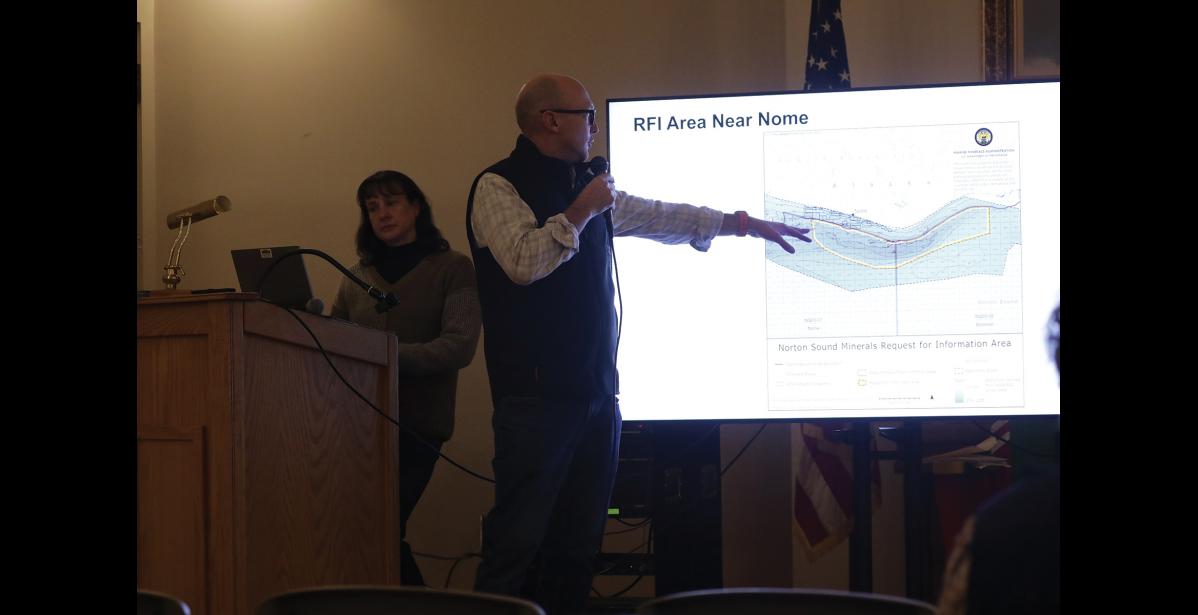
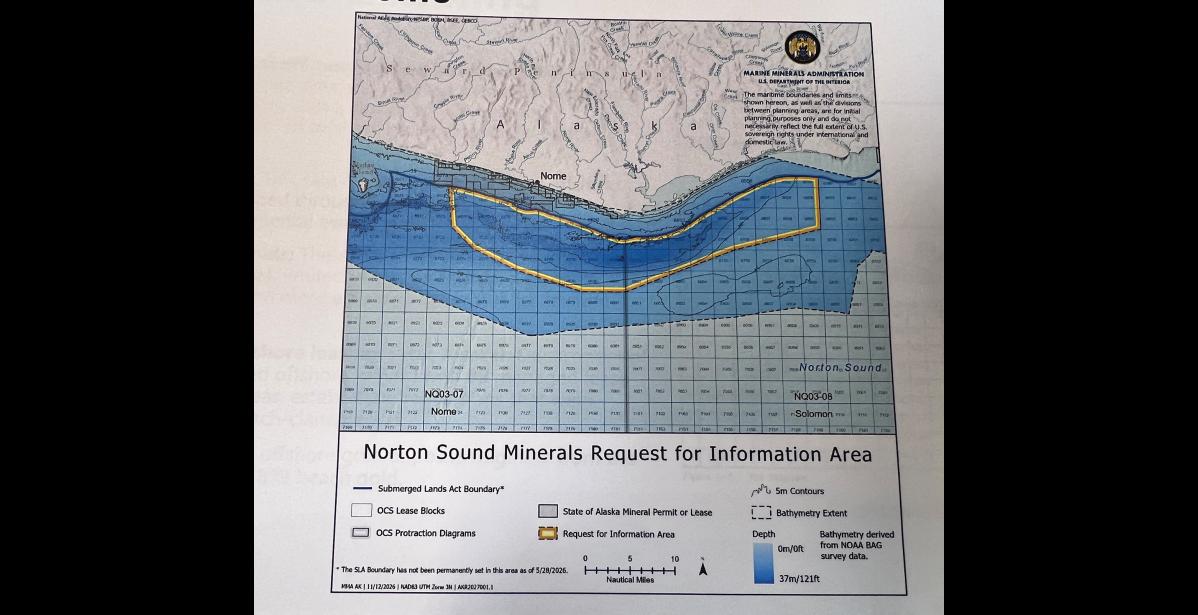
In January, a Request for Information, or RFI, was put out looking at over 113 million acres offshore around Alaska. One of the areas MMA is looking to lease out is off the coast of Nome for gold mining. From Safety Sound in the east, around Cape Nome, to roughly the Penny River in the west, three miles offshore.
Kawerak’s board of directors and the Alaska Federation of Natives approved resolutions in October supporting a moratorium on seabed mining, citing the unknown impacts to the ecosystem and marine animals. The Nome Common Council is considering a resolution to place a moratorium on seabed exploration, leasing or mining until its impacts are better understood but has yet to move on passing the resolution. This region is not alone in opposition. According to the New York Times, more than 45 countries have called for a ban or pause on seabed mining, which currently does not exist in any commercial form.
Regardless of resolutions, the federal process is already underway. Since the RFI period closed on April 1, MMA has been working to identify viable areas where lease sales could be considered.
The main reason offshore mining isn’t yet a thing: “It’s very challenging,” Mick Bradway, Alaska Regional Director of MMA said.
MMA and the Department of the Interior officials, including the deputy assistant secretary of the DOI’s Lands and Minerals Management, came to Nome last week in response to a request from tribes for government-to-government consultation, Bradway said. The agencies don’t plan to travel anywhere else in the state during this stage of the process.
Mining offshore
Offshore mining in U.S. federal waters has never been done before. The first-ever lease sale in U.S. territorial waters took place last week, a $6 million deal for 31.5 million acres off American Samoa to a U.S. exploration company. A U.S. District Court Judge in Hawai’i ruled that the auction violated the law by not considering the potential harms to endangered marine species, violating the Endangered Species Act.
A federal lease sale has been attempted in Nome before. In 1991 the government held a lease sale to mine gold offshore but received no bids. But recently companies have shown an interest again, Bradway said. Palmerosa Mining LLC applied for a permit to conduct prospecting in February of this year but has since withdrawn the application. However, there are plans to resubmit, Bradway said. Palmerosa has been gold mining offshore for years on state leases.
Most of the people who attended the Wednesday meeting at Old St. Joe’s were gold miners. Derek McLarty said he wasn’t as much interested in mining in federal waters as he was in what the lease sale could do for Nome.
When it comes to mining offshore, the further from the coast the more dangerous it gets. Federal waters begin three nautical miles from shore where the waves are bigger, ocean is deeper and things are harder to control, McLarty said. The dredges currently mining in state waters closer to shore are not cut out for deep water mining.
Ken Hughes, City of Nome Mayor and a miner, echoed this in his comments to the MMA during their presentation.
“One of the primary issues with offshore mining at the scale you’re proposing is that Coast Guard regulations [for dredges] are such that they make it impossible to be an offshore mining operation,” Hughes said.
Seabed mining has a different regulatory structure from offshore oil and gas extraction, which has an established history and track record. One glaring contrast: the state of Alaska receives royalties from companies that mine for gold or extract gas from state leases, but this is not the case for seabed mining, and it would take federal legislation to change that.
There’s also not a lot of data on how profitable it would be to mine for gold in federal waters, or even how much gold is that far off the coast of Nome. Studies haven’t been done in years and MMA is asking that companies foot the bill to conduct the exploration. But just because a company is permitted to prospect in an area doesn’t mean it’s guaranteed a lease there. This presents an incentive problem, Hughes pointed out.
Regulatory process
Any U.S. based company can conduct preliminary activities to assess the value of a mining area. These activities require a permit and include mapping of the seafloor with echo sounders and geological sampling with grab samplers or corers.
“Any seabed disturbance activities will require archeological resource review prior to sample collection,” Bradway said.
Without exploration and a full understanding of what’s out there, the project could destroy the seabed without ever producing gold, Nikolai Ivanoff, land manager at Arctic Gold, told the Nugget.
After areas to mine are identified the next procedural step is a National Environmental Policy Act review, or NEPA. This requires federal agencies to assess the environmental impact before making decisions. This process can take years, depending on if significant impacts are identified, and provides opportunity for the public to comment. After NEPA, a proposed leasing notice will be published in the Federal Register, this basically describes the lease terms prior to the sale so interested parties know what they’re getting into. Then the leasing notice would be published before the actual competitive lease sale begins. MMA has indicated it intends to have lease sales as soon as 2027, though officials visiting Nome did not state a specific timeline.
Tribal Consultation
The three-day meeting between tribal representatives and the government representatives has been in the works since May, Anna Rose MacArthur, Marine Advocate for Kawerak said. She, along with her colleagues, organized the meeting which began with a meal at the King Island Native Community Tribal Hall Monday night for everyone to settle in and meet each other.
One of the main goals, other than the tribal consultation on Wednesday, was to get the “decision makers,” or those who have influence over the process on the government side, in the same room with the people who will be directly impacted by those decisions so they can hear their thoughts and concerns, MacArthur said.
The topics discussed were both the potential of seabed mining offshore and the new federal oil and gas leasing plan which includes looking at a potential lease in the Norton Basin.
On Tuesday the meeting took the form of a full-day workshop at the King Island Tribal Hall where the seven visiting federal employees sat at tables with tribal representatives.
“This whole effort has flown under the radar for a really long time, so these discussions are integral for tribal governments and people in the region to understand exactly what’s happening,” said Deilah Johnson, tribal resources director for the Village of Solomon.
Concerns for the health of marine mammals, fish and ecosystems that are essential to the subsistence lifestyle were brought up.
Kawerak’s Executive Vice President of Operations Darlene Trigg pointed out that often the impacts of mining go beyond the environment and subsistence. She used the Port of Nome expansion as an example to illustrate the “unintended consequences” that can come from development projects. Examples include the increase of workers brought into the community and the safety concerns they can bring as well as the dust that blankets town as trucks move rock to the port.
There is a place for this information in the NEPA review, MMA Tribal Liaison for Alaska Jeff Brooks said, it’s not the data the agency typically collects but it can be done.
MacArthur asked if there was a way to permanently exclude Norton Sound from consideration for potential lease.
The answer is: kind of.
Casey Rowe, MMA’s regional supervisor for the Office of Environment, is focused on looking at ecosystem factors that could be significantly impacted. Vulnerable areas could be withheld from the sale, Rowe said.
As far as removing the entire Norton Sound region from being eligible for mineral or oil and gas extraction, that’s not how the regulatory process works, Bradway said. Technically, right now, any company or person with the qualifications can apply for a permit to mine in federal waters, Bradway said. The purpose of this initiative is to identify areas around the state that are viable and could be of interest for people to mine but without going through the full permit process, nothing can be ruled out.
Trigg pointed out that with MMA being on step two of the leasing process the wheels were already in motion, and only now are people in the region’s thoughts considered, not at the beginning or before the process started.
Trigg added that she was grateful that the group traveled, some all the way from Washington D.C., to engage with tribes and the community. “We invited you here in good faith,” she said, but still made sure to point out the dynamics at play.
“We didn’t ask for this and yet we’re forced to do this.” Trigg said, then repeated it. “We didn’t ask for this and yet we’re forced to do this. And that’s a problem.”