
Spring Temperatures
By Rick Thoman
Alaska Climate Specialist
Alaska Center for Climate Assessment and Policy
International Arctic Research Center/University of Alaska Fairbanks
Western Alaska — not the Bering Strait and St. Lawrence Island— was the only area in Alaska that was even a little bit warmer than normal in May, making up for the cooler than average March.
For spring (March through May) 2025 overall, the average temperature at Nome airport of 23.1°F was almost exactly normal. The highest and lowest temperatures in the spring of -17°F several days in late March to 65°F on May 26 were also typical for recent years.
What wasn’t usual, especially for the past decade, was the general lack of storminess and low precipitation totals.
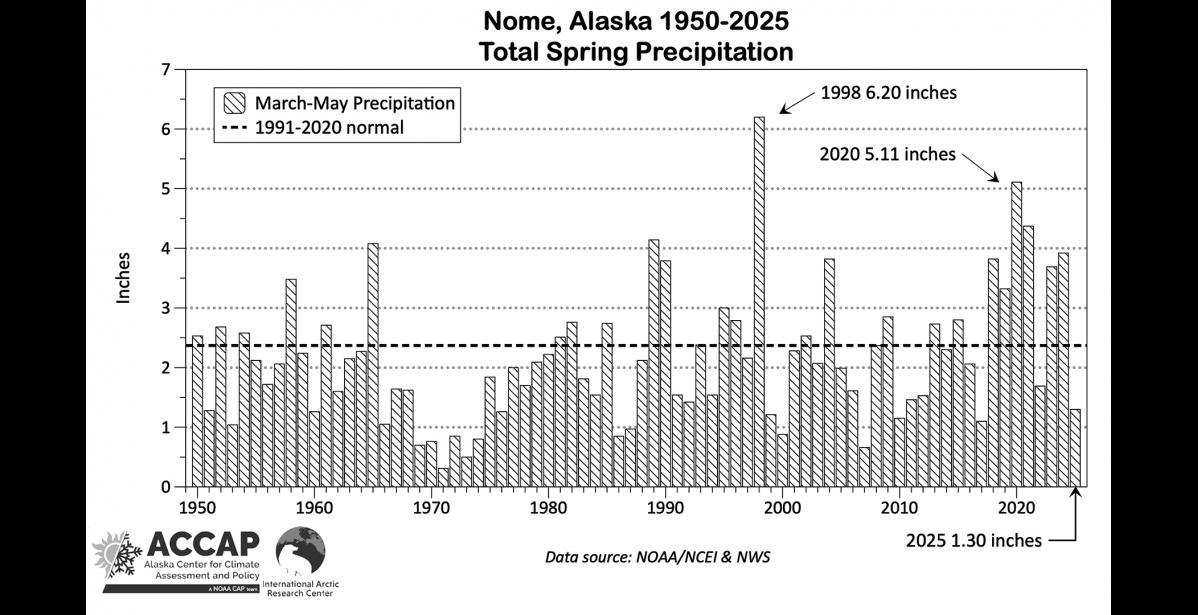
All three months had below normal totals, with the cumulative total spring precipitation (rain and melted snow) of 1.30 inches. This is barely half of normal and the lowest spring total since 2017.
An even larger difference is evident when comparing this spring to the past seven years, when in each spring except 2022 the precipitation total was 2 to 4 times higher than this year.
While spring sea ice extent in the Bering Sea was lower than average, meaning there was more water exposed to the atmosphere and increased evaporation potential, the storm track was mostly well to the south of the region. So, while as winter 2024-25 ended there was the potential for another snowy spring due to more open water, the large-scale atmospheric flow pattern was persistent enough that only the weakening remnants of storms were able to make it to the northern Bering Sea region.
While these weak systems were able to bring some snow and rain to the region, including some late-season snow after Memorial Day, the amounts were low compared to several recent springs.
A notable event for the end of May was a storm that hit Gambell with peak winds of 35 to 40 mph, and mixed rain and snow. Nome saw some trace amount of snow on Friday and cold winds on Saturday.
