
New dance group in Unalakleet revives tradition
Click here to see more images.
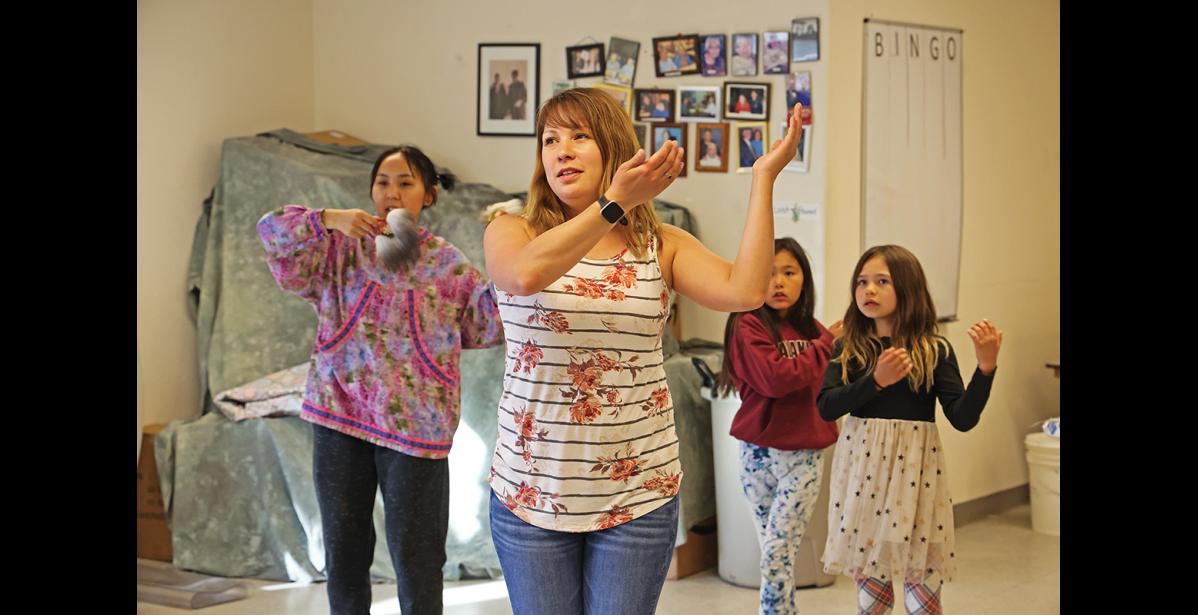
On a bright Sunday evening in July, a group of ten kids and adults gathered inside Unalakleet’s community center. They took out drums borrowed from the school, pushed a few of the tables normally used for bingo out of the way and started singing and dancing to a Yup'ik song about a goose on the beach that’s about to embark on its first flight.
“It’s kind of like our group because we’re still young and we’re still trying to take flight,” said Amber Cunningham.
Cunningham helped found the new Unalakleet dance group, which is called Uŋalaqłiq Iñuutchak, meaning “Unalakleet comes to life.” For almost a year now, they’ve been practicing Yup'ik and Iñupiaq songs twice a week, revitalizing a tradition that hasn’t existed in the town for more than a century.
“There have been attempts in the past to revive dance in Unalakleet, but it has faded,” said Cunningham. In early November, she met with her mother Carol Wilson, Linda Cooper, Laureli Ivanoff, Brianna Blatchford and Kelsi Ivanoff to create a community dance group that they hoped might last.
U.S. government policies and the arrival of missionaries had a devastating impact on the ability of Alaska Native communities to pass down their language and other traditions like song and dance. And in Unalakleet, the aspiring dance group had to get creative to start rebuilding a repertoire of songs.
The first song they practiced was a local one, the “Caribou Hunting Song” recorded by Thora Katchatag. The rest came from a variety of sources. Some were given by other dancers and singers. For example, Fred Mike of St. Mary’s taught them his “Grandparent’s song.”
NSEDC gave the group funds to bring in Ossie Kairaiuak from the Anchorage-based Inuit soul group Pamyua for lessons. A few members of the Unalakleet group who had experience dancing as kids, such as Wassillie Soxie, jogged their memory to piece together songs. The University of Alaska Fairbanks’ Iñu-Yupiaq Dance Group leader sent them videos and song lists. Others were learned from YouTube.
“As we’re starting out, we’ve pulled from wherever we could,” said Cooper. She taught in Bering Strait School District’s bicultural program last year and is passionate about explaining the meaning behind certain songs and movements to her fellow dancers during practice.
“I had no idea how this was gonna turn out, and then we’re here not even a year later—it’s very cool. I’m so proud of our group,” she said.
When Stebbins had its first potlatch since pre-COVID in March, the Unalakleet dance group was invited. The trip was symbolic because the last time Unalakleet had a public community dance group attend a potlatch was 1915—in Stebbins. The dancers said it was an eye-opening experience to see how strong their neighbors’ dance and song have been preserved over time.
“They had some super prominent singers—loud and proud and powerful,” Cunningham said. “I’ve never danced so hard in my life.”
Cunningham hadn’t actually practiced traditional dance until forming the group in November. Some kids in Unalakleet grew up learning at least a few songs and dances through the bicultural program in school. But she lived in Anchorage until she was 13, and the only time she saw Alaska Native dance growing up was at annual AFN conference. Cunningham recalled that her grandmother—who had been punished for speaking Iñupiaq in school in Unalakleet—refused to teach her kids the language and would avoid AFN’s Quyana nights.
Now three generations of the family attend the dance practices. Cunningham’s mom is the “official grandma” of the group, and her daughter Cassidy, who’s entering third grade, often comes to practice with friends in tow.
Bringing back a dance group in Unalakleet hasn’t been without discomfort. Some folks in town did not entirely welcome the effort. The Covenant Church had forced older generations to stop practicing their traditions, teaching that dancing was something sinful. Jacob Ivanoff, who occasionally drums with the group, said he thinks any lingering suspicions are based on a misunderstanding of the purpose of the dancing.
“The reality of the dancing is that you’re telling stories of being out in the country, hunting,” Ivanoff said. “That’s the way the men would get together in the qargi. That’s the way they had their entertainment—making jokes, making up songs, dancing, laughing, having fun.”
Frances Degnan, who stopped by practice last Tuesday to offer encouragement, said that those nights of storytelling through song and dance were also crucial for education.
“That was really our educational system,” Degnan said. “You learn your language, you learn your music, you learn your life ways. This is how our ancestors survived.”
In the weeks ahead, Uŋalaqłiq Iñuutchak will be raising money for upcoming travel through raffles and cake walks. They’ve now been invited to perform at the upcoming Teller Cultural Festival and at the Elders and Youth Conference in Anchorage ahead of AFN. Several of the dancers said they’re especially looking forward to the gathering in Teller as they’re trying to expand on their Iñupiaq catalog.
They also just look forward to the regular practices—full of laughter, teasing, inside jokes and self-expression. Cooper said she’s able to use dance and song as an outlet for feelings like anger, frustration and sadness. Wilson said she finds peace in dancing. Others added that the experience has been healing and helpful in navigating difficult moments, like recent deaths of community members.
“A lot of stuff has happened here over the last couple of years or so, and I think a lot of us probably agree that there’s a lot of healing,” Teri Paniptchuk said. “We’ve become a family. The group has become like a big family.”
They’ve even embraced extended family from other cultures. Last Tuesday, with a bigger group in attendance at practice, Karlee Katchatag’s Hawaiian fiancé Brysen Hoohuli was teaching the rest of the crew a thigh-burning hula, “Ka’a Ahi Kahului,” about the first train built in Maui.
On her way out the door that night, Degnan said she was excited to see the dancers not just finding ways to reconnect with traditions but also finding ways to keep the enthusiasm and happiness high among young people.
“It makes my heart warm,” Degnan said. “How do you keep the land unless people are happy and productive? I was born into a happy harmonious community and I want to leave it happy and harmonious. That’s my goal.”