
Operation Polar Dagger serves the purpose of deterrence
In the chaos of ex-typhoon Merbok that hit Nome and the region in September 2022, it escaped most that a special operations command of the military was holding the first iteration of Operation Polar Dagger on St. Lawrence Island. In the aftermath of the storm, military helicopters were speeding from the Nome airport, heading west, and the assumption was they went to assist Savoonga and Gambell to recover from the storm. Instead, the helicopters went to assist a SOCNORTH team of Navy SEALS that was hit by the storm by surprise and needed help to reconstitute their camp at Northeast Cape, after Savoonga residents rendered assistance.
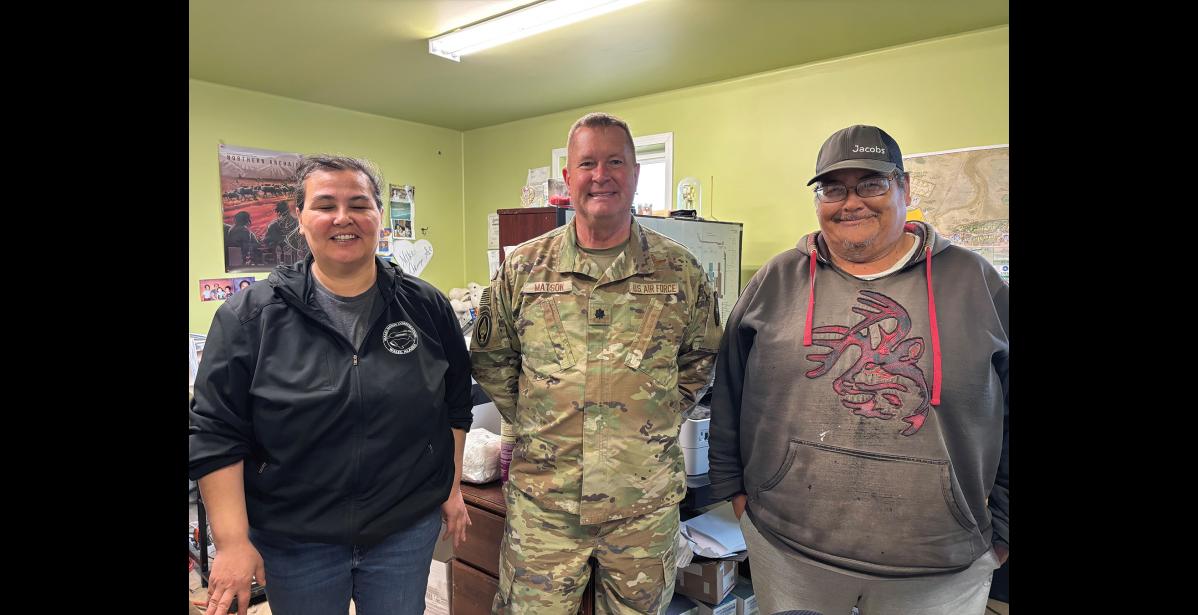
“We had a SEAL team on Saint Lawrence Island when Typhoon Merbok hit,” said Lieutenant Colonel Timothy Matson, the Arctic and Air Planner for Special Operations Command North, in a recent interview with the Nome Nugget. The team did long-range overwater movements from the camp at the old Northeast Cape Air Station. When the storm hit, the tents of the camp were blown away and destroyed. The special forces who were still at the camp took refuge in some vehicles and got into a low spot out of the wind. When Merbok subsided, SOCNORTH assessed the damage of the camp. With the help of the Alaska National Guard’s and Savoonga residents, the debris from the destroyed camp was collected, supplies replenished and the camp was rebuilt.
Now in its fifth year, Operation Polar Dagger is held again in the region but not until this year did the command agree to an interview to explain to the broader public the purpose of the operation. However, a colonel with the special forces held a Strait Science presentation in January 2025.
SOCNORTH stands for Special Operations North, a theater special operations command focused on the north. Theater is military speak for a defined geographical area where military events take place. Special forces are elite units in most military branches that carry out high risk and often covert missions that are beyond the scope of regular military forces. The Army Special Forces, or the Green Berets, and Navy SEAL teams, are examples of those specialized forces. Matson explained that these special forces, he refers to them with the military acronym SOF, are trained to conduct difficult missions with a smaller footprint than a larger conventional Army or Navy or Air Force would have, which would overwhelm smaller communities in rural Alaska.
The purpose: Deterrence
“The primary purpose of our Polar Dagger operations since the first one back in 2022 has been to show that we can get an effective small special operations force into the region at the time and choosing of our government,” Matson said. “We know that has a deterrent effect on any potential adversary that we have.”
He added that coming back year after year is enhancing the deterrent effect, not just showing up for a “once and be done.”
In addition to training the forces in Arctic environments, Matson said, the exercise helps develop relationships with the landowners, the Native tribes and Native corporations. SOCNORTH has developed land use agreements with the Native entities and hire local guides to further the exchange of knowledge, he said.
Another purpose of the operation is training the special forces in this region’s special environment and weather.
Matson said that since September 11, 2001, the nation has been focused on the global war on terror and on the Middle East.
When SOCNORTH was directed by Special Operations Command and the Northern Command to begin developing special operations options for homeland defense in the Arctic, the command found out that the knowledge of the past was gone. “When we got directed back in 2021 to pivot to the Arctic for Homeland Defense, we realized that a lot of that knowledge that the military had about the Arctic here in Alaska, Canada, Greenland during the Cold War was in many ways lost,” Matson said.
Re-learning
Things work different in Alaska as the environment and weather throws different conditions at people, materials and machines. “We realized we had a steep learning curve if we wanted to be able to effectively come and operate back in this area, and that’s where we are teaming with our fellow Americans, the Alaska Natives, and gaining that knowledge from them,” Matson said. One example he gave was the operations of weapons in the cold. In conversation with hunters in Utqiagvik, he learned that lubrication on weapons in the winter is a detriment to functionality. “It went against everything that I thought was correct,” he said. “They told me that in the winter up there, they completely strip all of their firearms of any lubrication that they have, and any optical sights, scopes, electronic sights. They just get rid of them because it’s so cold that the lubrication that I use on my weapons down in the Lower 48, would turn pretty solid, and the gun wouldn’t operate.”
Another lesson learned: during the second Polar Dagger exercise, they brought a military version of Razor side-by-side ATVs to St. Lawrence Island and – got stuck. These all-terrain vehicles work great in the Middle East, but not on St. Lawrence Island.
Matson also highly praised local knowledge and spoke of its value when it came to finding their way around the island at sea. As a highly trained SEAL team was getting ready to go from Gambell to Savoonga, one of the boat captains from Gambell came up to the team leader and inquired about their planned route to Savoonga. Around the mountain and then in straight line to Savoonga, was the answer. The Gambell boat captain warned that they would get really beat up in those smaller craft and suggested a course closer to the coast. The SEAL teams got their boats around the mountain but stuck to their original plan at first. They did that for about 10 minutes and got badly pounded by the waves, Matson said. They then took the suggested course. “It was a longer distance, but they made it in a shorter time with less wear and tear on their boats and equipment and themselves,” Matson said. “When I got a chance to talk to that team leader after the op when we were all in Anchorage, he said that was a very humbling experience,” Matson stated.
The current Polar Dagger exercise involves fewer than 50 personnel working alongside the Alaska National Guard and the U.S. Coast Guard. The operation takes place on St. Lawrence Island, near Tin City and Wales, and in Point Hope.
Matson said this year’s Polar Dagger is primarily operating on land and in the air. Lynden Air was contracted to get the equipment to the region; a New York National Guard C-130 brought the entire team to Tin City. The team then went to St. Lawrence Island and on to Point Hope. In the Wales and Tin City area, they have brought ATVs, and some of those military versions of the Razor.
And the role of Nome in all of this?
“Nome has been either a command and control center or a logistics hub,” Matson said. Nome is a so-called coordination cell of SOC North members, both civilian and military. “If we send fuel up to refuel the four wheelers that the teams are using, we’ll purchase that in Nome, send it on the way.” The same goes for other supplies. In addition to Nome being the home to an Alaska National Guard helicopter, Matson also appreciates the kindness of Nomeites and the comfort of a good meal and company at the VFW.
“Nome has been a fantastic location for all of our Polar Daggers, not just because of its physical location, and of course the larger airport that can take larger aircraft, but the people in Nome have been outstanding to work with,” he said.
The exercise would continue into the foreseeable future, Matson said.