
Graphite One holds open house in Nome
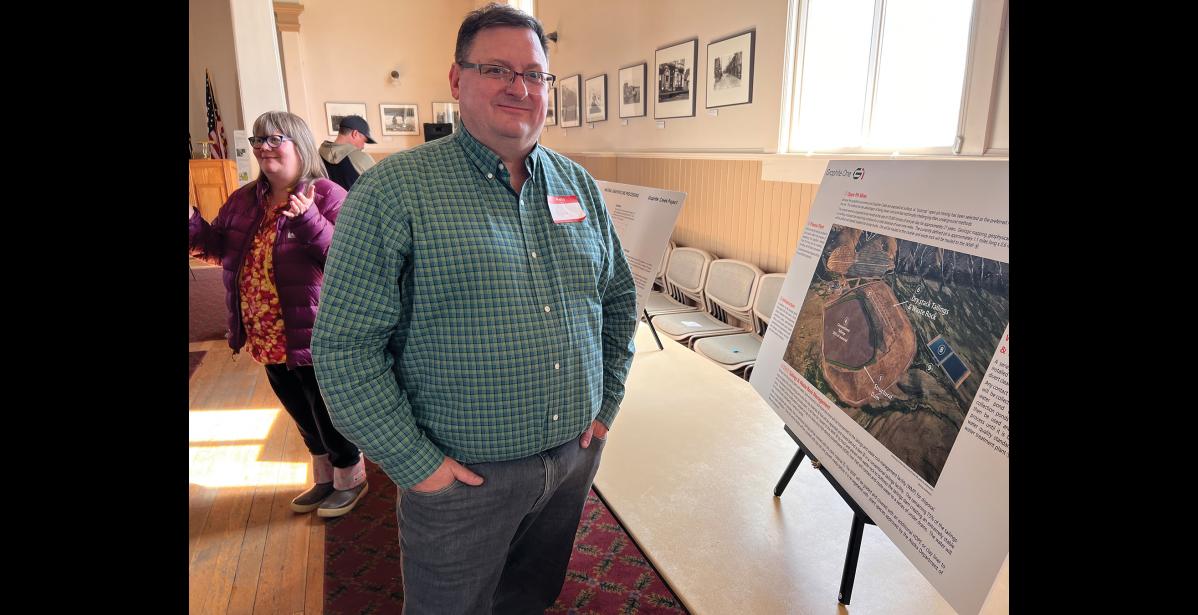
On a warm and sunny Sunday afternoon, Graphite One representatives invited the Nome public to an Open House at Old St. Joe’s to learn more about the proposed graphite mine in the northern Kigulaik Mountains. About 30 visitors found their way into the community hall, where Mexican food was catered, door prizes awaited and poster boards were set up with in-depth information on what the mine would look like, on job opportunities and on the permitting process.
Graphite One Alaska Inc, a subsidiary of the Canadian parent Graphite One Inc., has pursued the development of a graphite mine for nearly 12 years, conducted test drilling and environmental baseline studies. A Department of Defense infusion of $37.5 million helped the long-awaited feasibility study over the finish line, which then triggered the permitting process that has started last year. The project was accelerated and included in a federal FAST-41 permitting process that requires a tight timeline from regulators to review and permit projects that are deemed essential for the production of metals in the US.
As the specter of the graphite mine to become a reality is no longer a hypothetical, the communities of Brevig Mission and Teller have been increasingly outspoken to oppose the mine that is proposed to be built right in a prime subsistence area. In order to address concerns, Graphite One representatives have held regular meetings in Nome, Brevig and Teller to update the public on the plans and the complicated permitting process that is no small feat to understand. The company created a Subsistence Advisory Committee and according to project leaders, the feedback from the committee was incorporated in plans.
During the Nome meeting, G1 tried an Open House approach with the intent to facilitate more informal and direct dialogues. According to Senior Vice President of Mining Kevin Torpy, it had the intended effect: “I enjoyed having the more one on one contact with the people coming in, so we can answer specific questions and spend a little bit more time explaining their particular concerns versus our traditional approach, where we get up and talk through a bunch of slides and have Q and A after.”
This reporter then asked for a tour of the topics depicted on the posters. One poster boards exhibit showed the open pit as a 3D rendering, which Torpy said, would be also turned in a video and then released to the public.
Next was a complicated diagram of the floatation mill that is proposed to be built onsite. Torpy explained: “Similar to a lot of metal mines, the end product from Graphite Creek will be what we call a flotation concentrate.” The rock is mined from the pit, taken to a crusher with dump trucks. “The crusher takes that rock from 36-inch size down to six-inch size, breaks it down, and then that’s put under a covered stockpile that we’ll have on site, the reason we’ll have that covered is to keep dust from being generated off the pile due to wind,” Torpy said. From there, it will enter the mill, and that rock will be introduced into a water solution and put in a sag mill. Torpy describes it as similar to a clothes dryer, as it tumbles the rock with steel balls and pulverizes it down to a sand-like consistency.
As the rock is fine enough it will be put in a water solution. “We put them in tanks that are called flotation cells, and we start by bubbling air through that column, so real fine air bubbles going through, we add two chemicals to the process, diesel fuel and polyglycol, which is a soap, essentially. And that soap makes strong bubbles, and the diesel fuel makes the graphite want to repel water, so that it’ll attach to the air bubbles. So, as these air bubbles are going up through all these little graphite particles are trying to get away from the water, they attach to the air bubble, which floats up and into a almost like a soapy foam on top, and we scrape that off, that’s called concentrate, and that’s the mineral, everything that’s left behind is doesn’t have graphite in it, and that’s called the tailings.” This process transforms 5 percent graphite in the ore to a 95 percent pure graphite flotation concentrate that will ship out. The company envisions to truck double trailers with the concentrate in conexes to Nome on a daily basis and then ship them south. Preliminary numbers estimate shipping 8000 containers out annually.
Operating the mill requires a lot of power, in an area that is nowhere near the power grid. Torpy said the plan is to have three 7.5-megawatt generators at the mine and mill site. That is roughly equivalent to the Nome Joint Utility powerplant, powering all of Nome. There will be a diesel fuel tank onsite to supply the power generation. Fuel is to be trucked to the mine site by fuel trucks.
In order to build a mine at this remote spot, the company proposes to build an18-mile access road through Mosquito Pass. The State of Alaska just last week reissued a permit to Graphite One to allow a drill rig over the tundra and drill geotechnical test holes along the proposed road corridor. In addition, the state would need to fix up approximately 30 miles of the Kougarok Road, a rough gravel road, to facilitate the access from mine to the Port of Nome.
Given the severe winter weather that sometimes even brings life in Nome to a standstill, Torpy said, yes, it would take an effort to keep the road open and, yes, there are costs associated with it. “There will be days where there will be white out conditions that will probably shut down operations until we can get it open, but by and large, we intend to operate year-round,” he said. The plan is to daily shuttle workers from Nome to their 12-hour shifts at the mine. The company envisions to create housing for employees in dedicated subdivision in Nome, with the option for employees to rent-to-own the houses.
Asked about recent comments made by Graphite One leadership regarding the finding of Rare Earth Elements at the graphite deposit, Torpy cautioned that REEs are not easy to extract and that the focus is on graphite. “Graphite really needs to carry the day,” he said. Some garnets found in the drill samples do have REEs on them, but it is not yet proven that the REEs are present in economic concentrations and if the REEs can be economically extracted out of the garnets. “Garnet is the second hardest mineral behind diamond in the world, so it’s not a trivial exercise to get it,” he said. “There’s a whole handful of these elements that are considered rare earths. Separating them out individually is quite a task. So, we see it’s an opportunity that we should follow up on, but we’re having not assigned any economic value to any of it yet, because we just don’t know.”
So what is in store for the 2026 season? Torpy said, more geotechnical drilling along the proposed access road to understand the ground conditions for the construction, and the quality of material from the gravel pits or rock quarries. The drilling would take place from June 15 to July 12.
On June 2, the Graphite One representatives traveled to Teller for meetings with the tribes and the Native Corporations there, and a public meeting in the afternoon. See story in next week’s Nome Nugget.